Microschool vs. Private vs. Public School: How to Choose
Table of Contents
Quick definitions
A public district school is the tax-funded school your address assigns, bound to state standards, state testing, and a state calendar. A charter school is also public and tuition-free, but independently run, with admission by lottery.
A private school is an independent, tuition-funded school that sets its own curriculum, admissions, and culture. In North Carolina, it registers with the Division of Non-Public Education (DNPE) and must administer a nationally standardized test each year.
A microschool is a small, intentionally designed learning community, usually 5 to 25 students, often multi-age, often part-time, built around each child’s pace instead of a grade-level bell curve. RAND’s 2025 research report estimates that between 750,000 and 2.1 million US students now use microschools as their main schooling provider. Legally, most operate under homeschool or private school statutes; in a NC homeschool-model microschool, the parent stays the director of record while the teaching, the peers, and the structure come from the program.
Side-by-side comparison
The honest comparison is not “which is best.” It is “which trade-offs can this child and this budget afford.” Here is where each model actually differs, with North Carolina numbers where they exist.
| What you’re weighing | Public district | Private | Microschool |
|---|---|---|---|
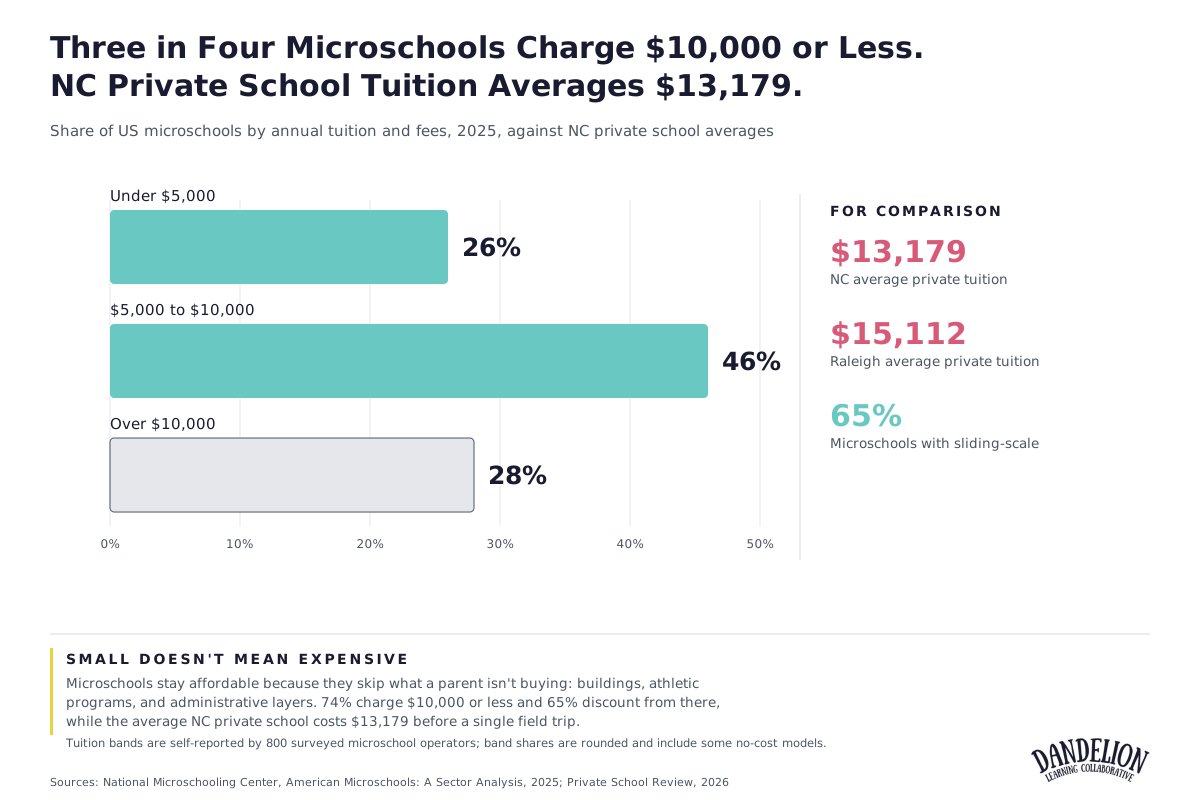
| Annual cost to family | $0 tuition | NC average $13,179; Raleigh average $15,112 | 74% charge $10,000 or less; 65% offer sliding-scale pricing |
| Class scale | 20 to 30 per class is common | Smaller classes, full-size school | Median 22 students in the whole school |
| Teacher credentials | State-licensed, required | Usually credentialed; varies by school | Varies widely; 54% of leaders are current or former licensed educators, so ask |
| Curriculum control | State standards and testing | School-controlled | Tailored to the child; mastery over seat time |
| Extracurriculars and facilities | Widest: sports, band, labs | Wide, varies by tuition tier | Thin by design; families supplement outside |
| Special education services | Legally guaranteed (IEP/504) | Not legally required | Not legally required; program-dependent |
| NC public money available | Fully funded by taxes | Opportunity Scholarship, ESA+ | ESA+ for qualifying students in homeschool-model programs |
| Schedule flexibility | None | Little | High; part-time and hybrid schedules are the norm |
Read the cost row twice, because it breaks the assumption most families carry into this decision: that small means expensive. The National Microschooling Center’s 2025 sector analysis of 800 microschools found 26% charge under $5,000 a year and 46% charge between $5,000 and $10,000, so 74% come in at or below $10,000, and 65% discount from there with sliding scales. Private School Review’s 2026 compiled listings put the average NC private school at $13,179 and the Raleigh average at $15,112. A family can buy a 1:8 ratio for less than a 1:15 one, because a microschool skips the buildings, athletic programs, and administrative layers a parent was never buying for their 8-year-old anyway.
Public school: pros and cons, and who it fits
Public school is the right call for more families than school-choice marketing admits, and we run an alternative program. The pros are structural and real: zero tuition, licensed teachers in every room, legally enforceable special education services through an IEP or 504 plan, transportation, meals, and the widest menu of sports, arts, and clubs in American childhood. No other model can guarantee that floor, because no other model is required to.
The cons are structural too. One teacher, one pace, twenty-five children. State testing sets the rhythm of the year. A child who learns faster than the middle of the class waits; a child who learns slower gets pulled along; a child who learns differently gets a label before an adjustment. None of that is a teacher failure. It is what any system built to move 1.5 million children through the same standards at the same age has to do.
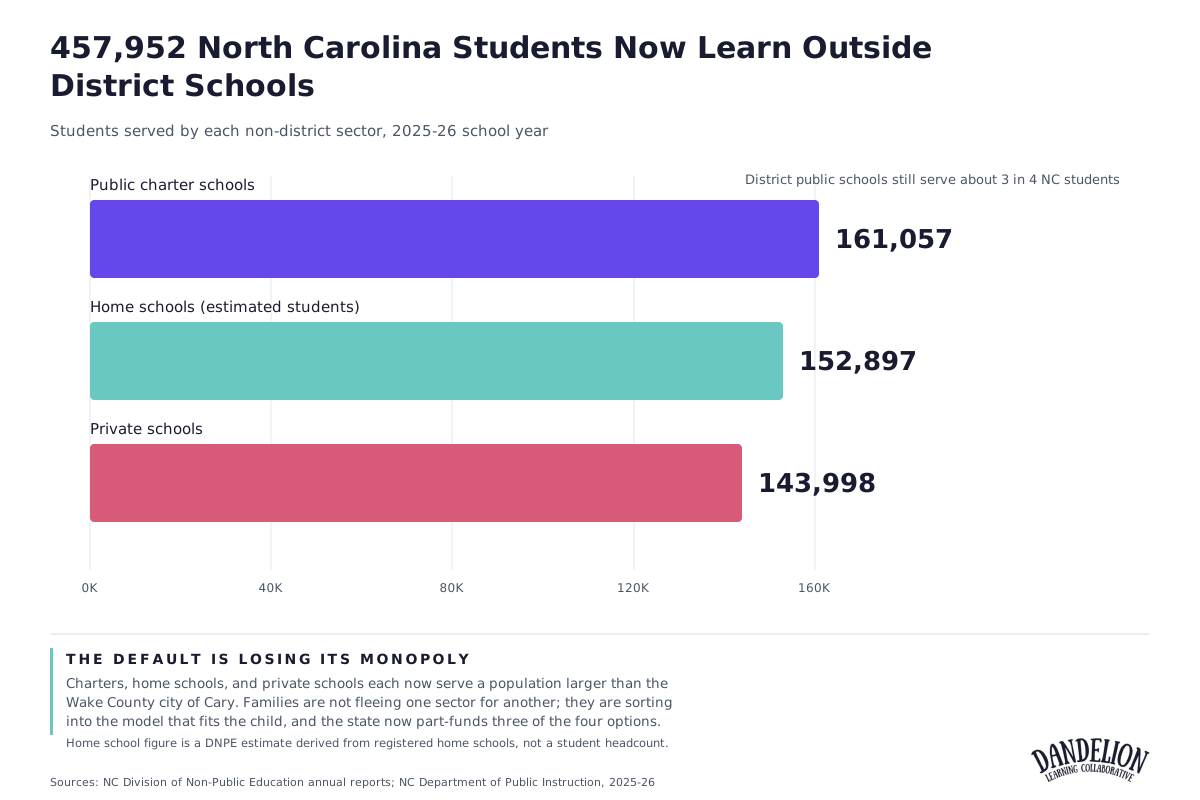
Public school fits your family if your child is doing well academically and socially, if enforceable disability services matter more than pacing, or if the budget has no room and no scholarship applies. District schools still serve about three in four North Carolina students. What has changed is the monopoly. Per DNPE and NC DPI 2025-26 annual data, 457,952 NC students now learn outside district schools: 161,057 in charters, an estimated 152,897 in registered home schools, and 143,998 in private schools. Each of those sectors alone now outnumbers the population of Cary.
Private school: pros and cons, and who it fits
Private school sells three things: smaller classes, a chosen culture, and a credentialed institution with a transcript colleges recognize. For families who want a full-size school, a full-day schedule, varsity teams, and a diploma pipeline, and who can pay for it or win a scholarship, it delivers.
The cons hide in the fine print. Tuition is the visible cost; the invisible one is that a child placed in private school by their parents waives the right to the special education services public schools must provide, and NCSEAA states this directly: a private school has no legal obligation to serve a student’s disability. Culture is chosen for you as much as by you. The structure is still one grade, one pace, one classroom, just with nicer bathrooms and 15 students instead of 25. Paying $13,000 does not buy a different model of learning. It buys a smaller version of the same one.
Private school fits your family if the child does well in conventional classrooms and you are buying community, rigor, and continuity through 12th grade, not a different way of learning. If what your child needs is a different way of learning, tuition size is the wrong lever.
Microschools: pros and cons, and who they fit
The microschool’s core advantage is not size. Size is the means. The advantage is that a 22-student, multi-age community can run mastery-based pacing that a 500-student school cannot: the 7-year-old and the 10-year-old building the same circuit at the same table, each assessed against their own last month instead of a grade-level average. Among microschools that track academic growth over time, 81% reported one to two years of gains in a single school year, per the National Microschooling Center’s 2025 analysis. That figure is self-reported by operators whose families chose these programs, so treat it as a direction, not a controlled result.
The cons deserve equal daylight. Quality varies enormously in a young, lightly regulated sector; only 22% of microschools are accredited, and credential levels swing from veteran licensed teachers to enthusiastic amateurs. There are no varsity teams, no marching band, no chemistry lab, and most programs cannot provide speech or occupational therapy on site. And a part-time model assumes an adult at home or flexible work on the other days, which many households do not have. A microschool is the wrong fit if you need full-day, five-day coverage, if your child’s services are anchored in an IEP the family cannot replace privately, or if your teenager’s path runs through AP courses and recruited athletics.
Who does it fit? The child the big room is quietly failing: the advanced kid who stopped trying, the anxious kid who disappears in a class of 28, the neurodivergent kid whose accommodations exist on paper but not in practice, the homeschooling family that has the “why” figured out and needs certified teaching help with the “how.” North Carolina’s own numbers show that consolidation happening. DNPE’s home school statistical history shows estimated homeschool students jumping from 149,173 in 2019-20 to a pandemic peak of 179,900 in 2020-21, holding in the 150,000s for years, then dropping 7.5% to 152,897 in 2025-26, the first fully funded universal voucher year. Families are not abandoning home-based education. They are trading the solo kitchen-table version for supported versions someone else helps fund and staff.
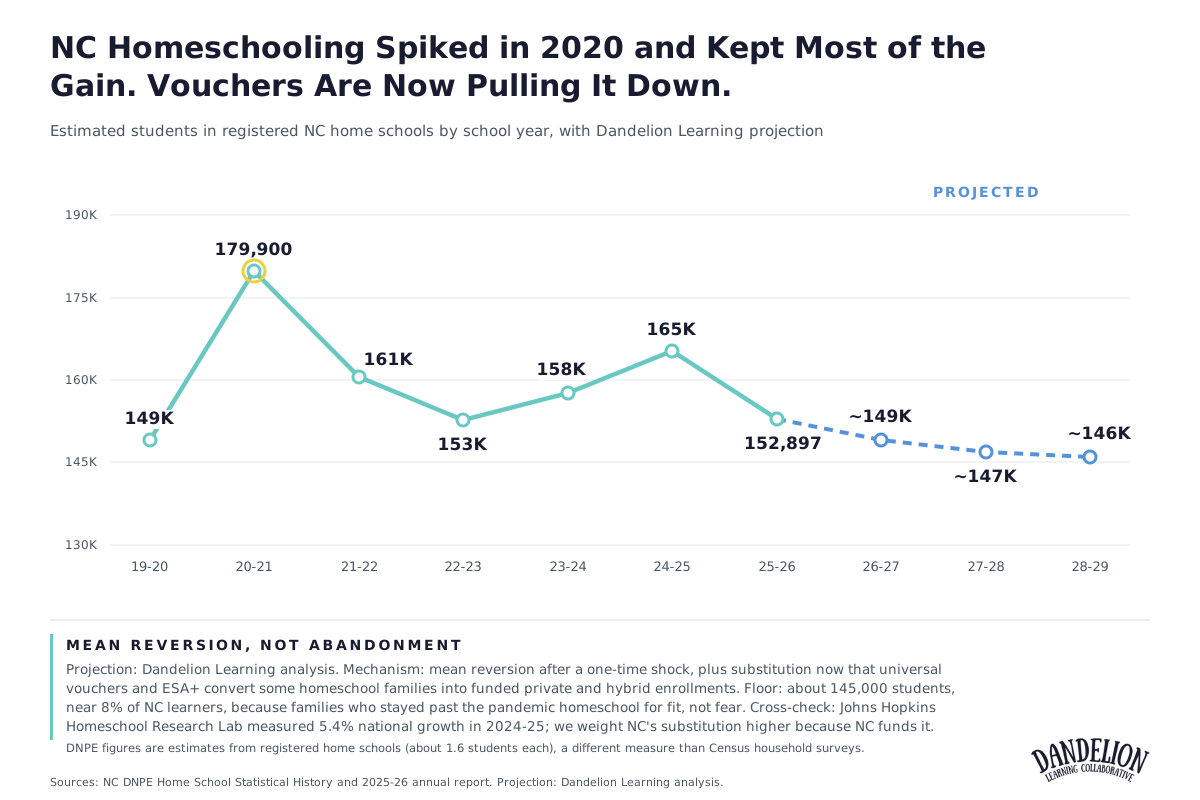
Projection: Dandelion Learning analysis based on mean reversion after a one-time shock plus substitution into funded private and hybrid options, assuming a floor near 145,000 students (about 8% of NC learners) because post-pandemic homeschoolers stay for fit rather than fear, cross-checked against the Johns Hopkins Homeschool Research Lab’s measured 5.4% national homeschool growth in 2024-25.
What about funding in NC?
North Carolina now funds alternatives to the district school more aggressively than almost any state, and the details decide which model is actually affordable for you. Two programs matter, both run by NCSEAA.
The Opportunity Scholarship pays private school tuition on an income-based sliding scale, $3,458 to $7,686 per student in 2025-26, rising to $3,574 to $7,942 for 2026-27, with every NC family eligible since the 2023 expansion removed income caps. The ESA+ program serves students with qualifying disabilities: $9,000 a year at the base level, $17,000 for certain designated disabilities, spendable on private school tuition or, for homeschool families, on approved educational expenses. That second clause is the one comparison articles skip, and it is the one that matters here: ESA+ money can follow a child into a homeschool-model program, which is how state funds reach microschool families like ours. The Opportunity Scholarship cannot; it pays registered private schools only.
Now the honest caveat about vouchers. Recipients tripled from 32,549 in 2023-24 to more than 104,000 in 2025-26 after eligibility went universal, but the NC Office of State Budget and Management’s 2024 analysis and DPI data show only 8.4% of new 2024-25 recipients came from a public school. The program mostly funds choices families had already made, so the curve is bending: the already-private pool is close to spent, appropriations cap total awards, and the state’s 997 private schools hold 143,998 seats. We project roughly 123,000 recipients by 2028-29, saturating in the 125,000 to 130,000 range. The planning consequence is concrete: apply in the February priority window, treat the award as a discount rather than a plan, and if your child needs out of a bad situation now, do not spend a year waiting on a lottery.
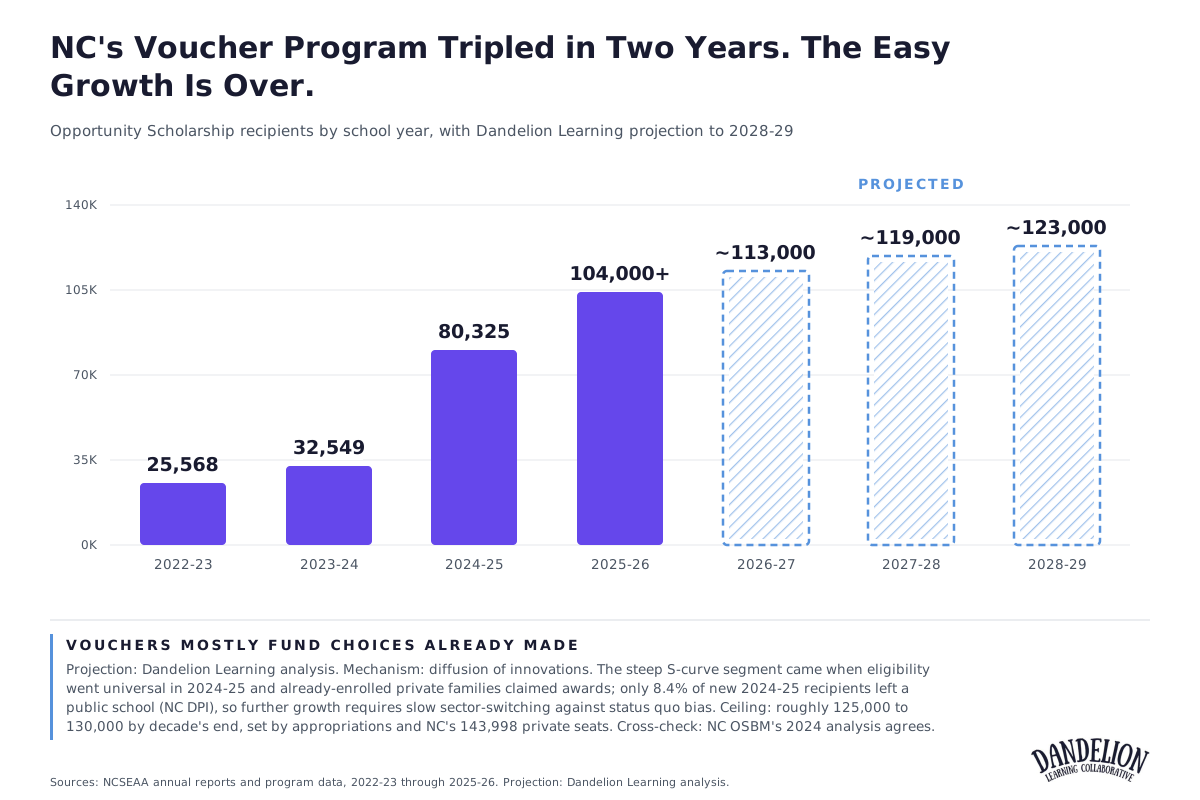
Projection: Dandelion Learning analysis based on diffusion of innovations, assuming a ceiling of roughly 125,000 to 130,000 recipients set by legislative appropriations and NC private school seat capacity, cross-checked against the NC OSBM’s 2024 finding that most new awards went to families already enrolled in private schools.
One more NC-specific fact worth its own sentence: homeschooling here is not fringe. It is roughly 8% of the state’s students, and registering is a one-page notice of intent to DNPE, attendance and immunization records, and one nationally standardized test a year.
How to decide: questions to ask yourself
Start with the child, not the school. If your child dreads Monday morning, that is data, and we treat it as seriously as a report card. A generic checklist will tell you to weigh academics, cost, and logistics. Here is what we would actually ask a family across the table.
How long does your child take to recover from a school day? A child who needs two hours of silence after dismissal is spending their learning energy on coping. What happens when your child finishes early, and what happens when they fall behind? The answer tells you whether the model bends or the child does. Which is doing the heavy lifting, the school or your dinner table? If you are reteaching every night, you are already homeschooling with extra steps. Can your household cover a part-time schedule? Would a $7,000 program plus $6,000 of tutoring or therapy beat one $13,000 tuition bill? And the question nobody asks out loud: is the child fine and the parent restless? Do not move a child who is doing well to solve an adult’s itch.
Then commit to a direction. For ages 5 to 12, when a school is failing a child, pick the smallest environment your budget and schedule allow and scale up later if the child outgrows it. Families make the small-to-big move smoothly all the time; the big-to-small rescue usually happens a year later than it should have, after the shutdown has already set in.
Where Dandelion fits
Dandelion Learning Collaborative is the “homeschool with help” model described above, built in Wake Forest for families across Rolesville, Raleigh, Youngsville, and the Triangle. Children ages 5 to 12 attend part-time, drop-off days in multi-age Montessori-inspired classrooms with a 1:8 staff-to-student ratio, taught by state-certified teachers with more than 80 combined years in classrooms and homeschools, supported by licensed counselors, because social-emotional growth counts as much as academics here. We are secular and radically inclusive: neurodiverse learners and families of every background are welcomed as they are, not as a marketing line. We accept NC ESA+ funds.
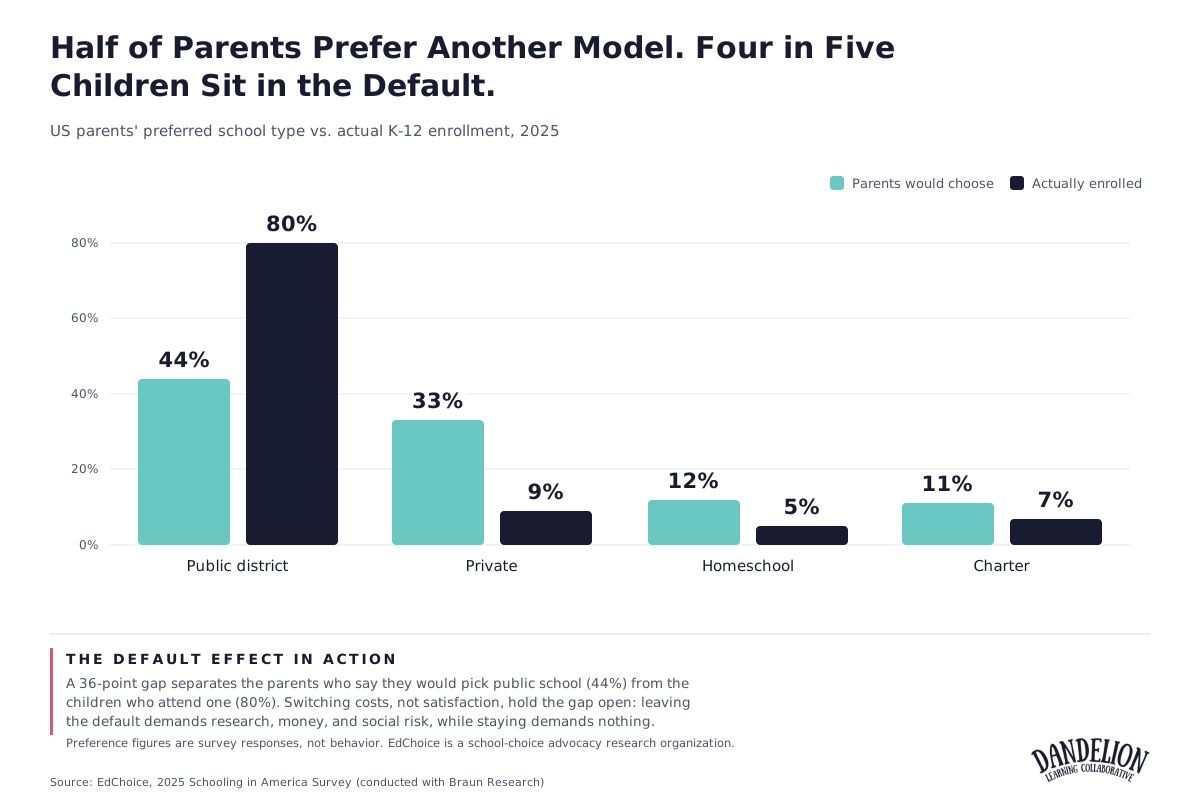
We end where we started, with the 36-point gap. Half of parents want something other than the default, and four in five children sit in it anyway, because switching takes research, money, and nerve, and defaulting takes nothing. You have now done the research, and you know which North Carolina money lowers the cost. If public school is working for your child, stay with our blessing. If it is not, that gap closes by decision, not by default. Come tour a Dandelion day and watch a small room work before you decide anything.