Montessori Schoolhouse for ages 5-12 is our touchstone program, with ample opportunities for outdoor play and exploration, studying with Montessori materials and K-8 content learning, guided choice, and certified educators.
Our Schoolhouse is an elementary Montessori classroom for ages 5-12. With multi-age groupings and certified educators, we prepare the room for all ages – and content learning for kindergarten to eighth grade. Our work cycle includes planning, choice, connections with peers and content, and reflection. We believe and find that this is an ideal experience for homeschoolers seeking to complement and expand their learning at home.
At Dandelion, we meet each child with curiosity, connection, and community, supporting them emotionally and academically to become confident learners and compassionate community members. Our intentionally designed, Montessori-based curriculum provides high-quality K-8 learning for personal development, literacy, math, science, nature, social studies, and community. These opportunities are available to all students each year and feature multiple entry points, ensuring every child can find success and chances to grow. Our robust menu of choices empowers children to explore topics that ignite curiosity, foster motivation, and make their learning engaging and comfortable.
We consider the development of the whole child to be the key to meaningful growth and learning. In this, we provide ample opportunities and guidance to ensure that all children are able to develop self-discipline, choice, confidence, and connection within themselves, with others, and with content.
Math
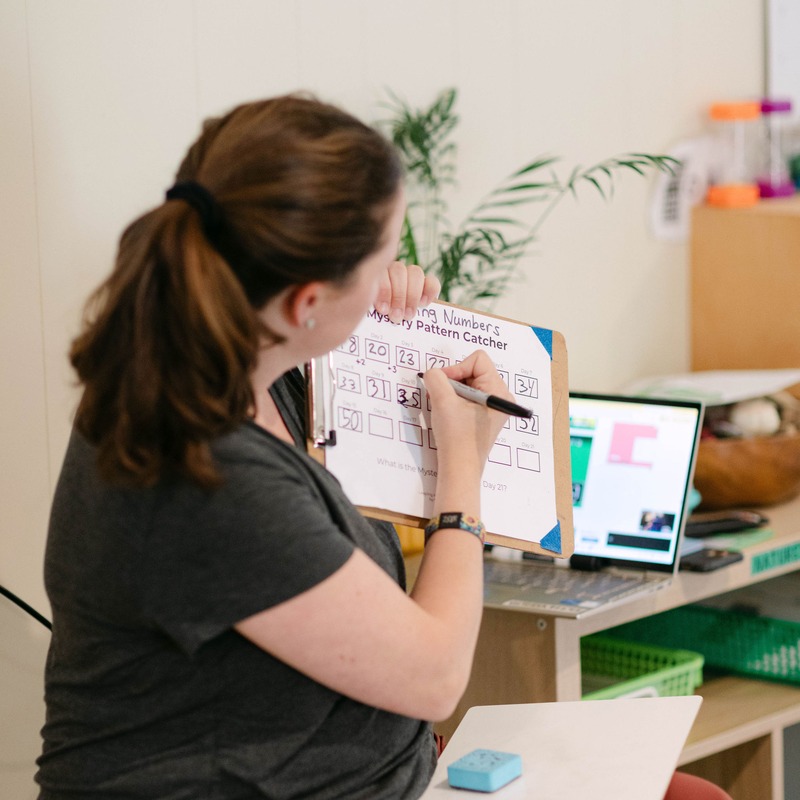
Our approach with mathematics is hands-on and interactive to start. Our room is set with Montessori Materials such as Beads and Blocks as well as games, Math Talks, puzzles, and modern tools – all for building understanding through middle years content.
Social Studies
Social studies is where we consider how humans interact with our world and with each other. We explore human geography, history, and social interactions. We use research, discussion, and story to learn about those who share our experiences and to learn from those who have experiences unlike our own.
Sciences
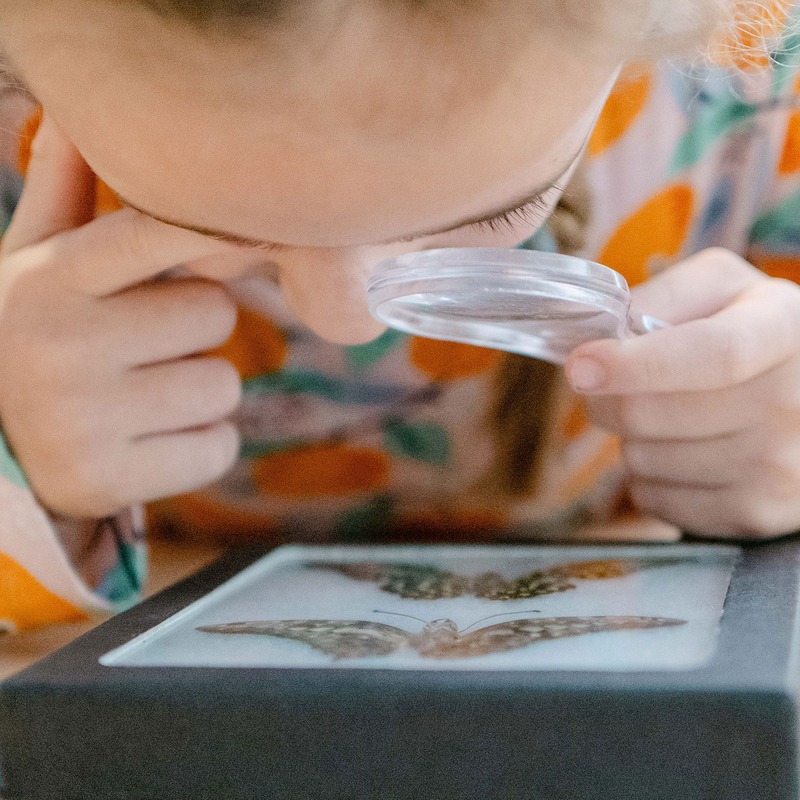
In our space, science is learned through inquiry and action – questioning, experiments, research, and data collection. Topics in our curriculum include ecology, biology, geology, zoology, and physics – all taught in relation to our real world.
Literacy
We provide ample materials and experiences for children to explore literacy and language on their own, with peers, and with direct guidance from educators. Our approach integrates concrete Montessori materials, early experiences with writing/use of letters, phonics, and authentic and meaningful texts.
Practical Life
We believe that, through care for themselves, others, and their environment, children learn responsibility, independence, interdependence, care, concentration, skills, and a sense of belonging. In the Schoolhouse, this means that we support students in identifying their own wants and needs, provide appropriate ways for them to fulfill them independently, and foster teamwork with care for our space.
Peace and Service
We invest deeply in meaningful relationships with ourselves, others, and the greater community. Mindful pauses, journaling, and opportunities for service are all embedded within our practice. This allows all members to experience autonomy as well as support for learning with the community.
Nature
We find that young people experience reassurance and growth when given ample opportunity to share time together in nature. All meetings include time outside together – both simply and with intentional lessons, texts, journals, guidance, and shared wonder and joy.
Multi-Age Groups – The Advantage
All of our programs operate as a one-room, multi-age schoolhouse. We know that not all kids are ready for K-8 content when the grade-level schedule demands it, so we keep all of it at the ready for kids ages 5-12 in our space and provide it to match each kid’s personal readiness.
Having members ages 5 to 12 allows us to truly celebrate diversity and all its forms. Older children naturally help younger children, and it makes sense. Younger children naturally ask for help from older children and can get it.
Children who are “young” or “old” for their age get to experience relationships with children who are younger and older than them.
Children with learning differences and children who are academically gifted can find materials and peers to develop skills that may not be available in a single-grade-level classroom.
Being multi-age also allows us to include and celebrate sibling relationships. While many families will notice competition and comparison pop up when older and younger siblings enter grade school, we instead see older and younger siblings celebrate and support each other.
Staying with the same teachers and younger and older classmates allows them to be seen and understood more deeply as they develop. Children get to invest in relationships that are lasting and won’t expire in June with graduation to the next grade’s classroom.
Self-Directed Learning – Kids Learn More
No one needs to learn everything; that would limit our uniqueness and our ability to develop a meaningful understanding of what matters to us. What we do instead is notice and nurture the learning that kids are ready for, interested in, and ready for the next step with.
We know that kids learn A LOT – especially when they’re given lots of opportunity to work at their own pace and with high-quality educators, materials, and tools. Every two weeks, our educators “set the room” and prepare a written Menu of Works with entry points for K-8 learning across all areas: Math, Literacy, Phonics, Social Studies, Science, Nature, Art, Personal Development, and Community. Our shelves contain books, maps, tasks, Montessori tools, and materials for children to explore and engage with classmates and teacher guidance and support.
Each day, children explore our room and menus to make a plan for their own work-cycle in their journals. They share this plan with teachers, who offer guidance and support as well as observe and record while the group is working.
A Typical Day – That’s Not So Typical
Morning – Montessori Schoolhouse
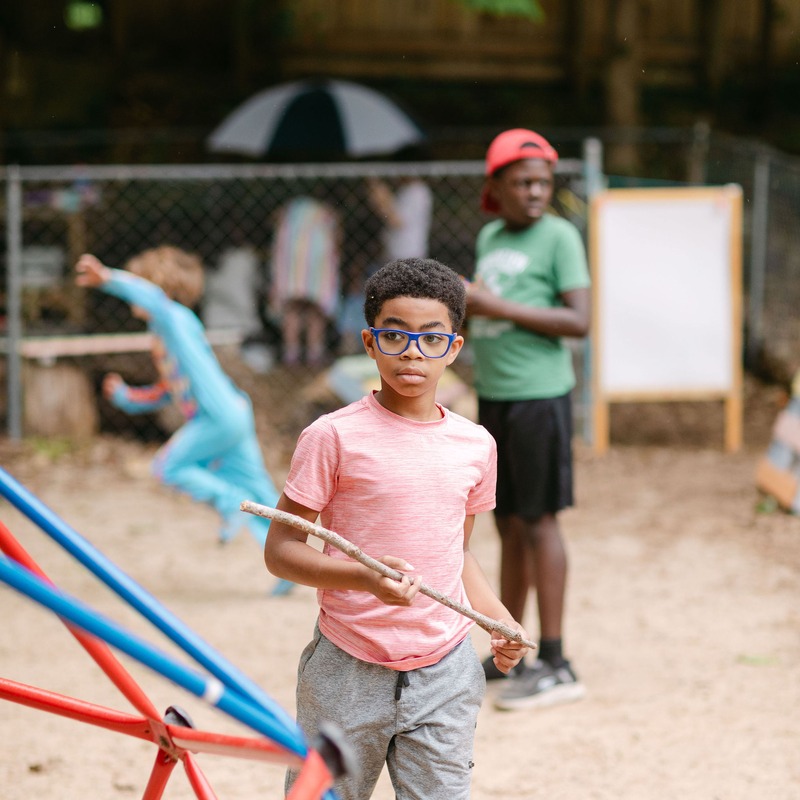
Morning Arrival & Outdoor Connection: Children start their day outside to spark wonder and imagination. They dive into group games, explore nature, connect with friends, and create using our extensive loose parts collection in the garden, natural play area, and playground.
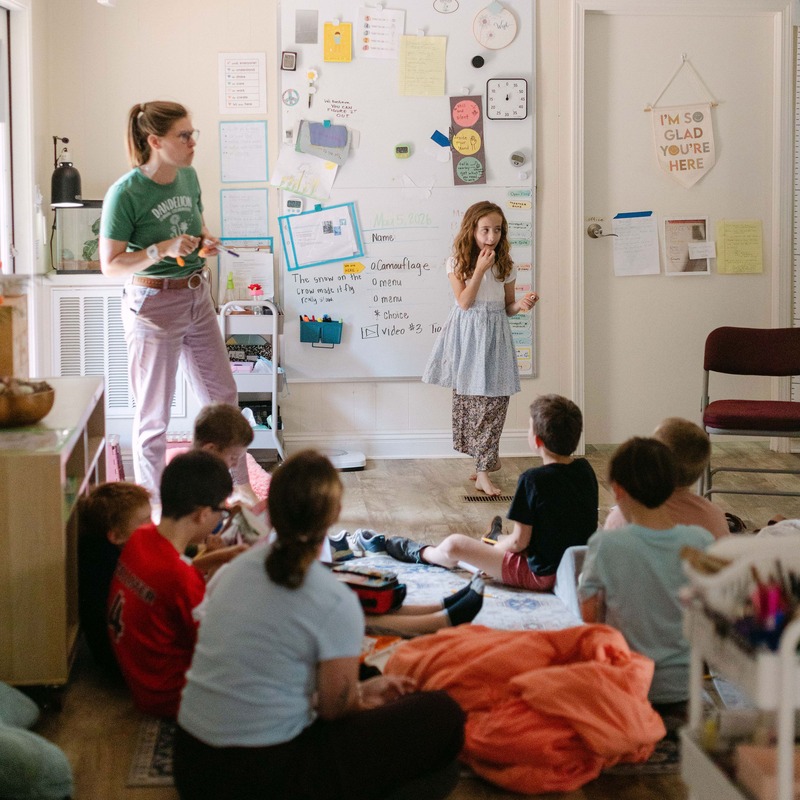
Circle Up: We gather indoors or outdoors for a fun group game or activity. This special time builds our community, allows for quick announcements, and helps us plan our day together.
The Work-Cycle: Children use personalized Menus to choose and plan their core lessons and choice activities. They write down their ideas in their journals and share them with a teacher before jumping in. This helps teachers prep materials and support their choices. Journals are at hand all morning for notes, while teachers observe, guide, document, and interact along the way.
Closing Circle: Our whole group gathers to share what we learned, take notes, and plan for future discoveries. Every child packs up their own belongings and completes a “Practical Life” task to tidy up and care for our shared space.
Lunch Club & Mid-Day Transitions: This supervised outdoor time bridges morning pickups and afternoon drop-offs. It truly belongs to the children and their friendships! You will often see field games, jump rope, mud kitchen cooking, gardening, and complex imaginative building projects during this flexible hour.
Afternoons – Montessori Schoolhouse with Academics, STEAM
Afternoon Arrival & Outdoor Connection: Just like the morning, we begin outside! Children run, play, and connect with nature and friends and our outdoor learning collection, playground, and garden.
Circle Up: A community gathering to kick off the afternoon with games, announcements, and gathering ideas.
Focused Lesson or Project: We start with an engaging, teacher-led lesson. This looks a bit more like a traditional classroom, featuring lively discussions and tasks from our Spiral Curriculum.
Mindful Moment: A quick, active or peaceful transition time for children to stretch, move around, play, and restore focus.
The Afternoon Work-Cycle: Children continue their project tasks or use their Menus to choose self-selected activities. They map out plans in their journals and check in with a teacher for guidance and next steps. Teachers are side-by-side with students throughout the cycle to guide and observe.
Closing Circle: We come back together as a group to share highlights and reflect. Children practice practical life and responsibility by packing up their bags and completing a quick clean-up task to prepare our classroom for the next day.
*An everyday peek into the classrooms: SeeSaw Journals
Throughout every session, our teachers capture special moments and a photo deck of your child’s experience. After each class, we share these photos alongside a detailed story of what we explored, the materials we used, and what we created inside our private Seesaw App classroom journal.
Choosing Your Scheduling Options
At Dandelion, families select and keep their own custom schedule throughout the academic year. Choose 2 to 6 half-days per week, add Lunch Club, and make planned adjustments as your child grows. Tap the sessions below to build your week.
Mon
Tues
Wed
Thu
Mornings 9 - 12
12 - 1:00
Afternoons 1 - 4
0
half-days / week
0
full days
—
Lunch Club / month
Tap sessions above to build your family's week — choose anywhere from 2 to 6 half-days.
Morning Programs
9:00 AM – 12:00 PM
Best for: all ages (5–12), especially younger learners and children who thrive with plenty of activities, choice, and active engagement.
Available: Mon/Wed, Tues/Thu, or Monday through Thursday.
Lunch Club
12:00 PM – 1:00 PM · Mon–Thu
Best for: everyone – especially those seeking more social opportunities and/or an extension to their child’s day at Dandelion.
$24 monthly fee regardless of days attended — automatically included when children attend both morning and afternoon sessions on the same day.
Afternoon Programs
1:00 PM – 4:00 PM
Best for: members ages 7+ who prefer academic focus, structured lessons, and shared group experiences.
Mon & Wed: shared literacy or math concept. Tues & Thu: interactive STEAM projects.
The Classroom Environment
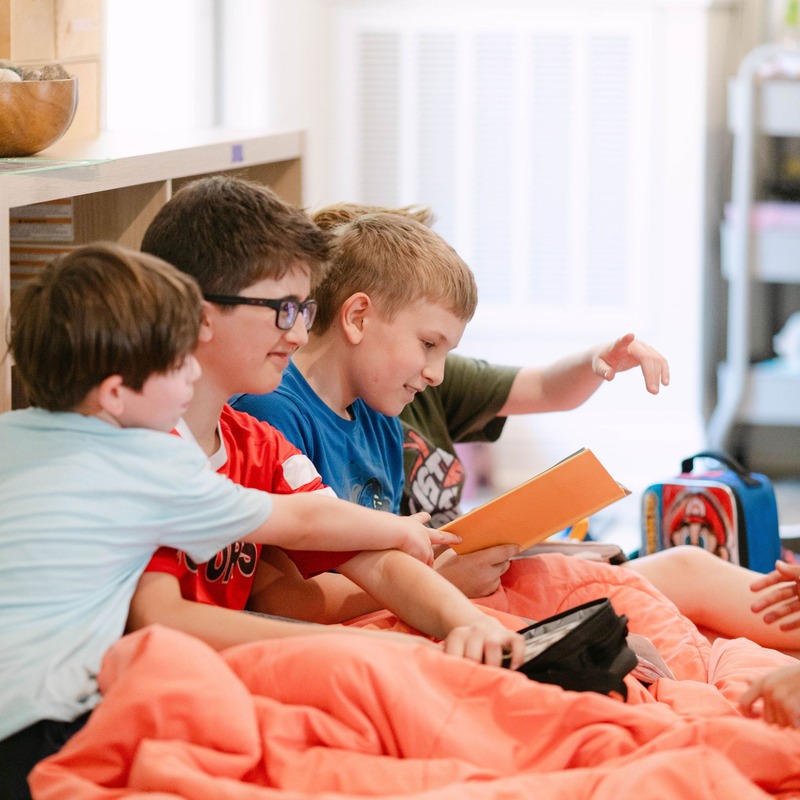
Our Classroom Environment is designed for access, comfort, and active use by children. Unlike a traditional classroom with one chalkboard as the central place for learning to happen, our Schoolhouse is set for learning all over the room. You will see clearly organized shelves with materials and tasks for Science, Arts, Mathematics, Literacy, Phonics, Nature, and Social Studies explorations available to all children. You’ll also notice a variety of workspaces – child-size tables and chairs, standing work tables, floormats, pillows, a quiet room, a few hammock chairs, and clipboards to boot.
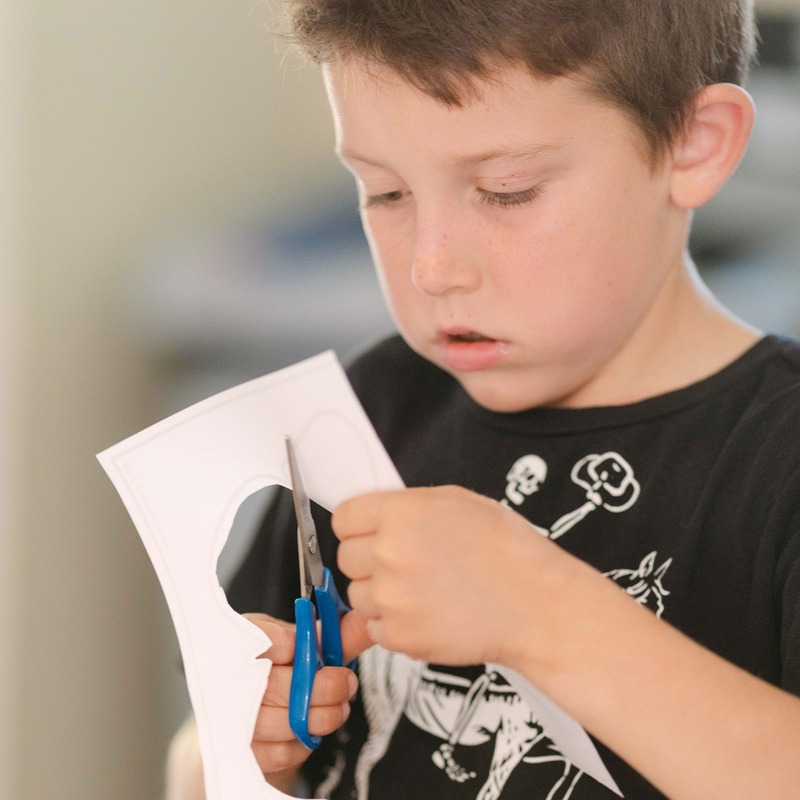
We curate and offer rich storybooks and informational texts to match our studies – use many Montessori Materials including the iconic Pink Tower, Decanomial Beads, Map Puzzles, Globe, and Moveable Alphabet – and share experiments, games, art, and projects too! You’ll notice all of these alongside printed lists for each subject area – as well as an abundance of art supplies, building blocks, puppets, and other open-ended learning materials for choice work and learning through play.
Yes, you can mix and match programs! However, to build strong community connections and consistency, we do recommend that all students to attend at least two sessions per week. You are free to choose whichever sessions work best for your family.
For two full days of Montessori Schoolhouse: We highly recommend choosing the Monday–Wednesday morning and afternoon schedule.
For four half-day sessions: Monday through Thursday morning or afternoon sessions are available.
Note: Aligning with these recommended schedules is not required, but it ensures your child experiences the school week with a more consistent group of classmates and teachers.
All children are welcome here, regardless of their schooling background! Our educators have extensive experience in both Montessori settings as well as traditional public and private schools. Because our approach is highly personalized, we know how to meet your child exactly where they are and support them as they adapt to our rhythm at their own pace and comfort level.
We use a flexible, multi-age approach that applies progressive learning with state standards. When building our curriculum menus and tracking progress, we blend:
The Montessori Progressions and the National Council for Teachers of Mathematics (NCTM) standards, which focus on deep conceptual learning in multi-age bands.
The NCDPI (North Carolina Department of Public Instruction) and Common Core State Standards to ensure that your child remains completely aligned with conventional school expectations should they ever transition back.
We prepare our environment with math tasks that offer multiple entry points. This allows us to offer open-ended, adaptable lessons that challenge advanced learners while providing tailored support for students building foundational skills.
Just like our math program, our literacy curriculum blends Montessori Progressions with the NCDPI and Common Core State Standards. Fortunately, the hands-on way Dr. Montessori taught language aligns beautifully with the core skills the state expects students to learn.
We know that reading development doesn’t always follow a rigid timeline. We equip our Schoolhouse with K-8 tools, materials, and texts covering phonics, grammar, reading, writing, speaking, and listening. Instead of restricting your child to a fixed grade level, we give them direct access to the exact materials that match their current mastery and unique learning pace.
We don’t use traditional grades, but we do observe, record, and document your child’s progress.
Daily Student Reflection: Children record their work plans and reflections in their personal journals every day.
Daily Teacher Documentation: After every session, our educators share a photo deck and a detailed narrative on the Seesaw app.
This creates a transparent, living portfolio that provides meaningful encouragement, avoids criticism and comparison – and shows you exactly how your child is growing, learning, and mastering new skills!
We design our learning environment to match the natural developmental needs of elementary-age children—a framework backed by Dr. Maria Montessori, numerous experts in child development, and decades of research – so that they have the opportunity to develop what they need for the next, natural in adolescence and adulthood. By doing so, we help children build a foundation of confidence, problem-solving, and communication that conventional classrooms simply do not allow.
Here is how we do things differently at Dandelion Learning:
We Protect Childhood for the Adults They Will Become: In traditional settings, a child’s natural drives to move, explore, make choices, and ask questions are often dismissed or restricted by adult control. Here, movement, curiosity, wonder, and mistakes are actively encouraged and become meaningful moments for teaching and learning.
We Build Independence: Instead of making every decision on their behalf, we teach children how to plan their day, solve their own problems, trust their instincts, and communicate effectively to advocate for themselves and learn with others.
We Prepare Them for the Future: Combining this deep personal responsibility with a strong academic foundation gives our members a unique edge. When they move on to conventional high school settings and beyond, they don’t just get by—they thrive as academically prepared, self-confident, self-directed, motivated, effective, and deeply engaged learners.
It is our belief that, by providing elementary age children with a learning environment that is a match for elementary age development- as observed by numerous historical and contemporary theorists, sociologists, and medical professionals, including Dr. Maria Montessori, we are also providing them with a solid foundation of confidence, planning, problem solving, and communication as teens and adults that cannot be achieved in traditional public and private school settings.