Curriculum & Standards
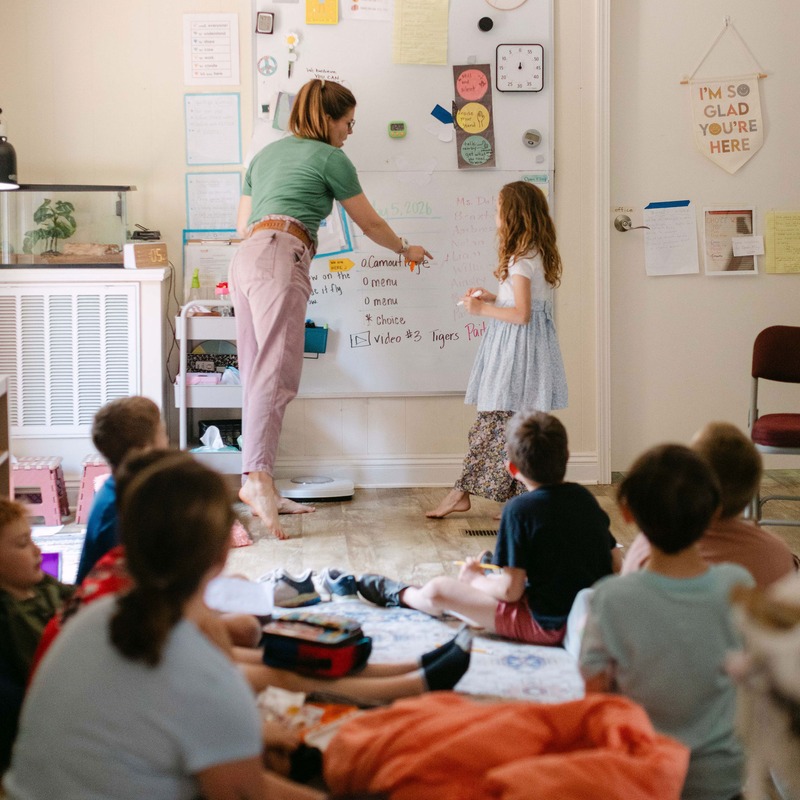
At Dandelion Learning Collaborative, we emphasize learning for the whole child and honoring the gifts of learning in childhood. As Dr. Montessori advised, we “follow the child, but follow them as a leader.” This means that it is our responsibility to recognize and provide opportunities for learning in all areas, not just academics.
Schedule A Tour
Our Curriculum
We organize our curriculum into seven core categories, balancing structured state standards with a child’s natural curiosity. Rather than forcing every student down the same path, we guide and follow each child as they develop personal mastery.
In these areas, we use our own uniquely designed in-house programs to connect learning to real life:
- Personal Development: Focuses on “practical life” skills and self-care. You see this in our shared routines, cleaning-up, mindful practices, and group “together games.”
- Community: Emphasizes communication, collaboration, and service learning—both within Dandelion and through local, state, and global partnerships.
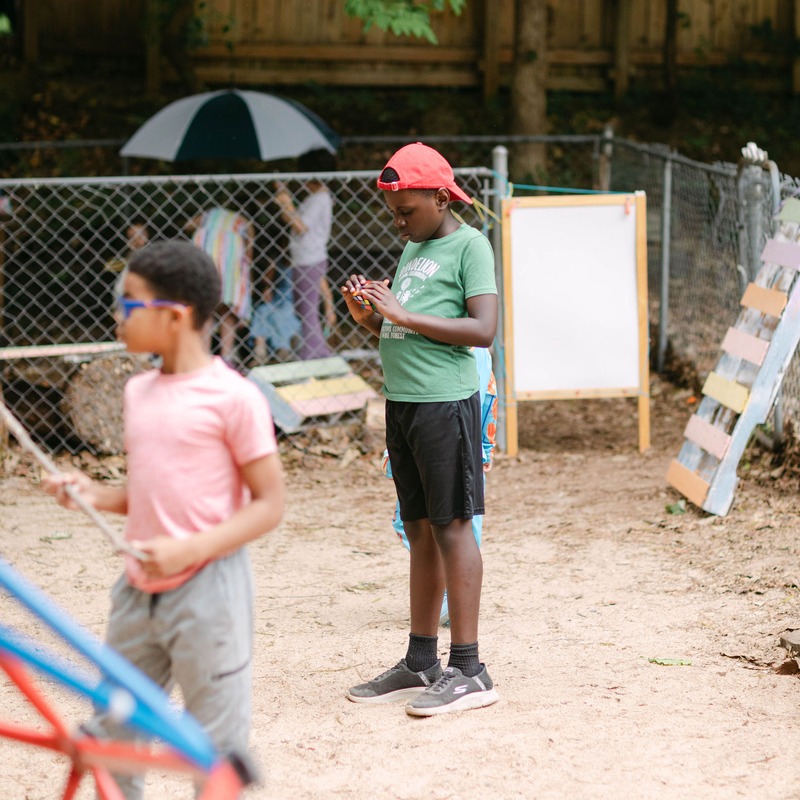
- Nature: Features seasonal, place-specific outdoor learning that naturally connects math, science, art, and literacy to the physical world around us.
Academic Standards & Individual Pathways
Because no two children share the exact same learning path, our educators ensure every student has a clear gateway to academic success:
- State Alignment: Our classroom environments are prepared with rich materials and lessons that employ Montessori and Self-directed learning strategies aligned directly with K–8 Common Core and NC State Curriculum Standards for math, literacy, language, science, and social studies
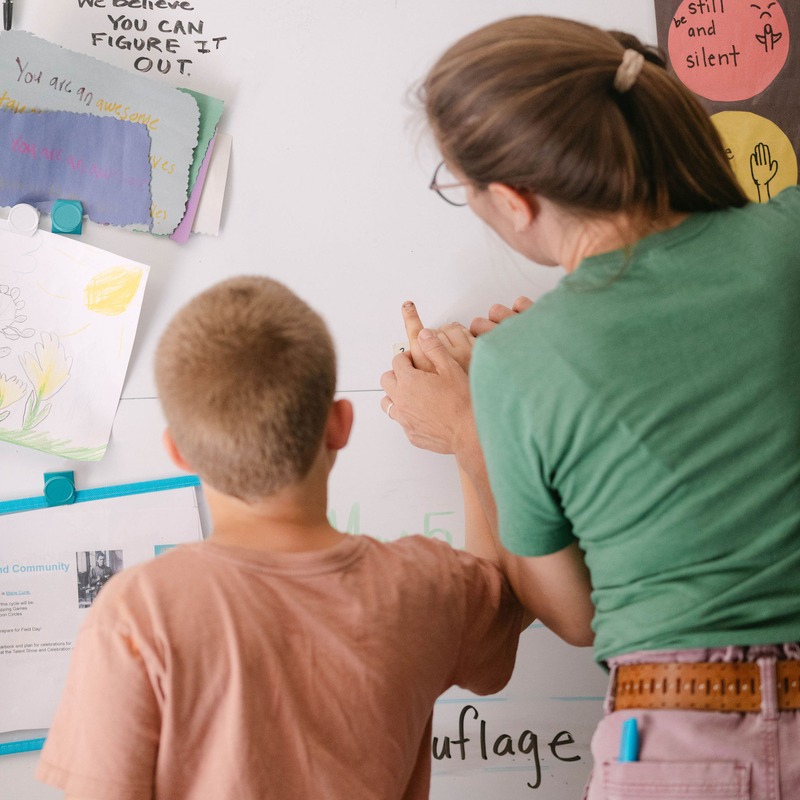
- Targeted Guidance: Teachers carefully introduce children to the “best fit” next-step materials and lessons for their specific developmental level.
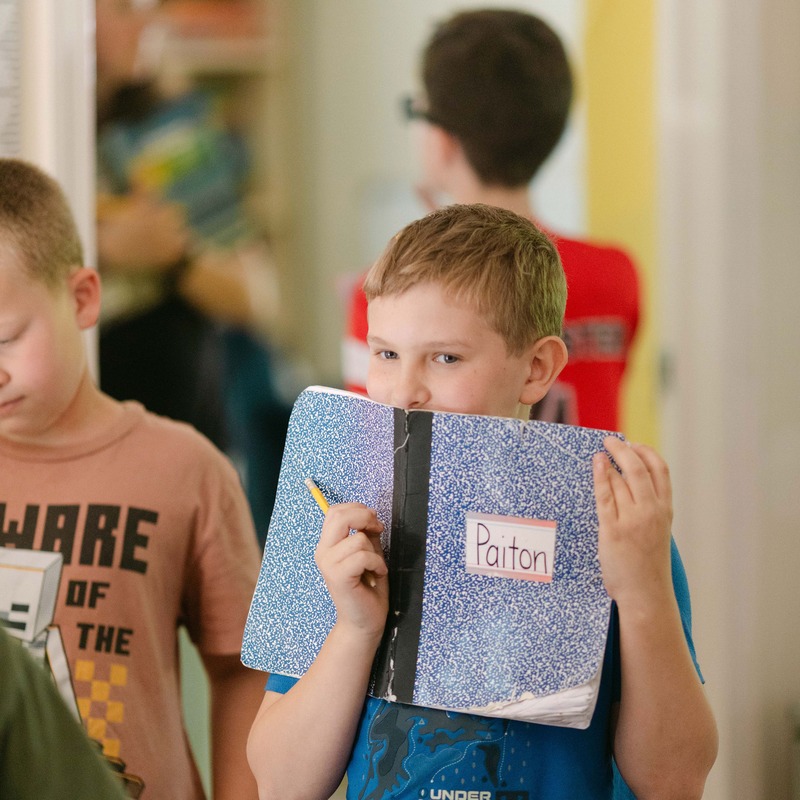
- Shared Records: Teachers and students collaborate to document daily goals, plans, and academic progress using personal journals and SeeSaw electronic portfolios.
Our Philosophy: Learning at the Speed of Childhood
Have you ever noticed how children naturally learn? They don’t absorb everything about a topic all at once. Instead, they circle back to ideas as they grow, adding new layers of understanding each time.
In the education world, this is called a spiral curriculum, but we just think of it as honoring human nature. By using hands-on and self-correcting materials, we help children connect real-world experiences to bigger concepts and carefully evaluate their own work, building deep, lasting knowledge that sticks with them for a lifetime.
A Different Approach to Growing Up
Conventional school models often bundle kids together by age, pushing everyone through the exact same assignments at the exact same time. While that might make standardized testing easier, it doesn’t align with how children actually develop. When learning is forced before a child is ready, it rarely sticks.
Think back to your own school days:
How much do you actually remember of what someone “made” you memorize for a Friday quiz?
Now, how much do you remember about the things you were genuinely curious about and ready to explore?
Meeting Your Child Exactly Where They Are
Every single child has their own beautiful timeline for learning. Our mission is to ensure that our classrooms and our educators and are always ready to notice, celebrate, and meet your child exactly where they are today—in every subject area.
Our Approach to Reading & Literacy – leading with skills and opportunity
In many self-directed learning spaces, you’ll find a “hands-off ” approach to reading— following the idea that if children are surrounded by books, they’ll naturally pick up reading all on their own. While that does happen for some kids, we take a slightly different, more supportive path.
As trained and certified teachers, we’ve seen firsthand that we can offer children powerful, proven reading tools without stepping on their independence or joy.
The Best of Both Worlds
We love blending the “how to teach” from the Montessori method with the “what to teach” from North Carolina state and Common Core standards. It turns out they overlap beautifully! Children are naturally wired to want to communicate in written form, and we make sure they have the absolute best tools to do it.
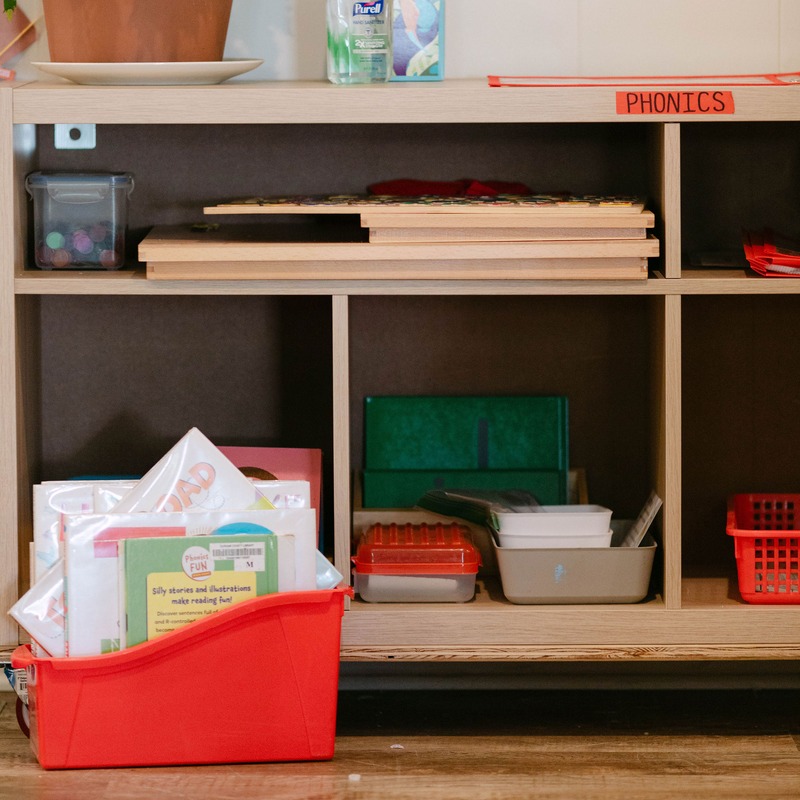
Our literacy program is hands-on, multi-sensory, and phonics-based:
- Building Blocks: Kids use wonderful, tactile materials like Montessori Sandpaper Letters and the Moveable Alphabet to physically build words as they learn to decode text.
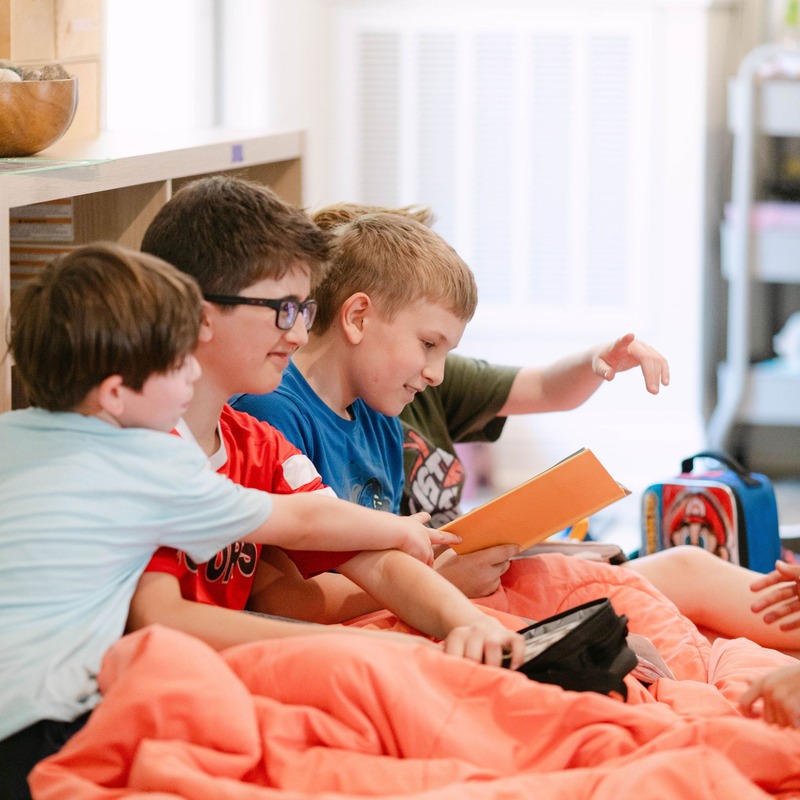
- Growing into Readers: Once those first building blocks are in place, we guide them as they dive into authentic, beautiful books, grow their vocabularies, develop understanding of grammar, texts structures, and figurative language and find their own voices through writing across all of our projects.
We don’t leave reading and writing to chance, but we never force it either. We keep the door open and give them the tools to walk through it confidently!
Mathematics Curriculum – Making Math Meaningful
Math isn’t just about worksheets and memorization—it’s a beautiful language that helps us understand our world. To give your child the absolute best foundation, we weave together the hands-on brilliance of the Montessori progression with the standards of the National Council for Teachers of Mathematics.
Because both systems look at math in age-spanning “bands,” we get to revisit core concepts repeatedly, letting your child build deep, confident understanding over time. Our math world covers everything from early counting and the base-ten system to geometry, algebraic thinking, fractions, percentages, and data. To make learning meaningful and lasting, we constantly apply these skills to the real world through science, art, and nature!
A Room that Works with Wonder
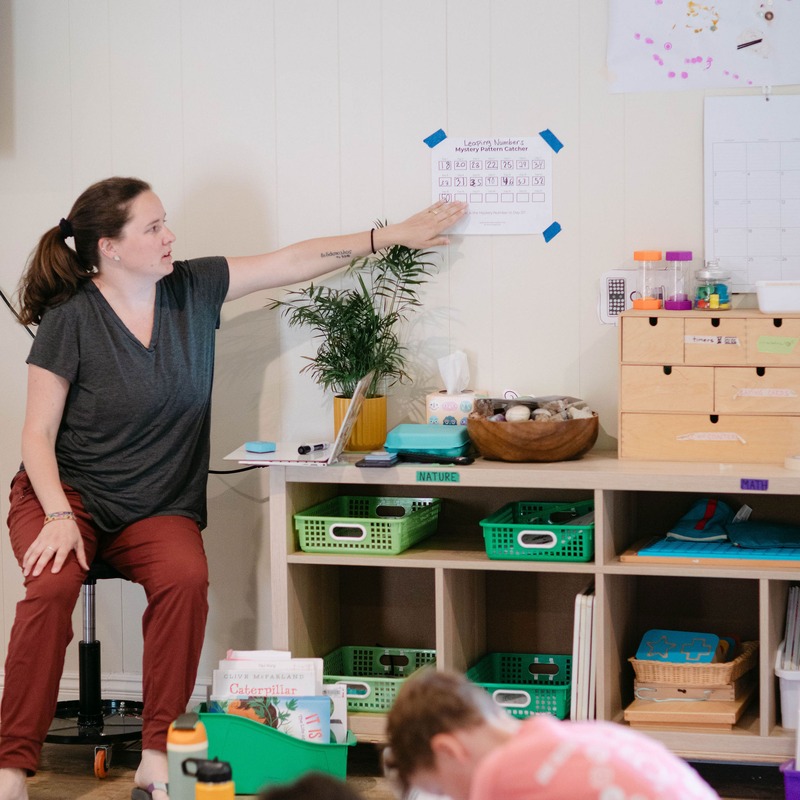
When you step into our classroom, you won’t just see calculators and pencils. You’ll find beautiful, iconic Montessori materials designed to make abstract numbers completely concrete:
The Golden Beads to physically feel and see the base-ten decimal system.
The Red Rods, Checkerboard, Decanomial Beads, and Strips for hands-on exploration of value and operations.
The Montessori Protractor and Geometric Insets – for hands on understanding of angles and geometric shapes
Geometric Solids, Nets, and Bi-nomial Cubes to interact with all three concrete
Real-World Tools including scales, rulers, protractors, calculators, and custom-selected math games ready for accessible, active, playful learning.
Building Bridges for the Future
We want to make sure your child is confident wherever their educational journey takes them. To ensure they have bridges to conventional schools down the road, we carefully cross-reference our lessons with North Carolina State and Common Core standards.
By setting up our classroom with activities that have multiple entry points, we make sure every child can jump in exactly where they are comfortable. Whether a child needs extra support or a bigger challenge, our open-ended math tasks adapt beautifully to every single learner!
Science Curriculum – Wonder, Explore, Stay Curious!
For us, science isn’t just subjects in a book—it’s an adventure! We provide a space where children get their hands dirty, ask big questions, and discover how the world works. We love connecting science directly to math and language, showing kids how to run real experiments, use the scientific method, and keep their own data records just like real scientists.
Our science curriculum spirals and layers over time, meeting and stretching beyond North Carolina K–8 standards. Together, we dive into amazing topics including botany, astronomy, ecology, chemistry, biology, geology, zoology, physics, and even weather and health systems!
Whether we are diving into a shared topic during our afternoon STEAM Project Labs or observing the natural world right outside our door, we make sure science is always filled with wonder and hands-on discovery!
The Big Picture: Cosmic Education
We weave rich informational texts and data collection with Montessori’s beautiful concept of Cosmic Education. This is a story-based approach that helps children see how interconnected everything in our universe truly is—from the tiniest atom to the vastness of space, and how we as humans fit into that big, beautiful picture.
Geography & History Curriculum
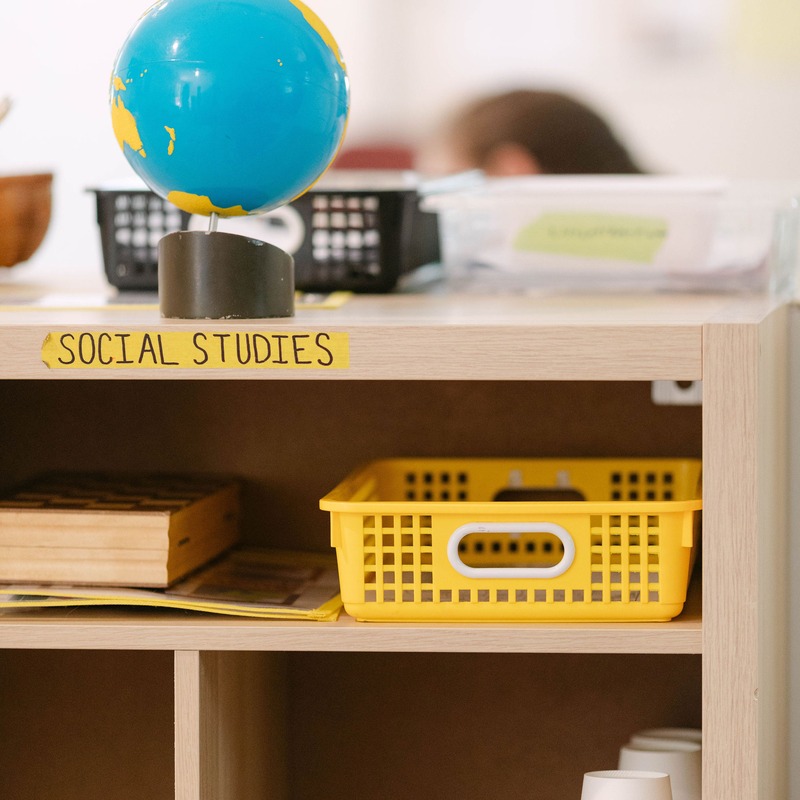
Social studies is all about exploring how humans connect with our planet and with one another! In our schoolhouse, history and geography come alive through stories, research, and deep conversations. We love exploring the world with people who share our experiences as well as those whose lives are different from our own.
In the Schoolhouse, learners get to map out their discoveries using wonderful tools and activities including:
- Montessori Map Puzzles and detailed Atlases to physically piece together our world.
- Fascinating stories and history books that make past events feel like real-life adventures.
- Creative cartography (map-making) projects and research assignments where kids can document their own learning.
By blending story, discussion, and real-world application, we help children build a compassionate, curious understanding of history and the global community we all share!
Art, Music & Movement Curriculum – Woven into Everything We Do!
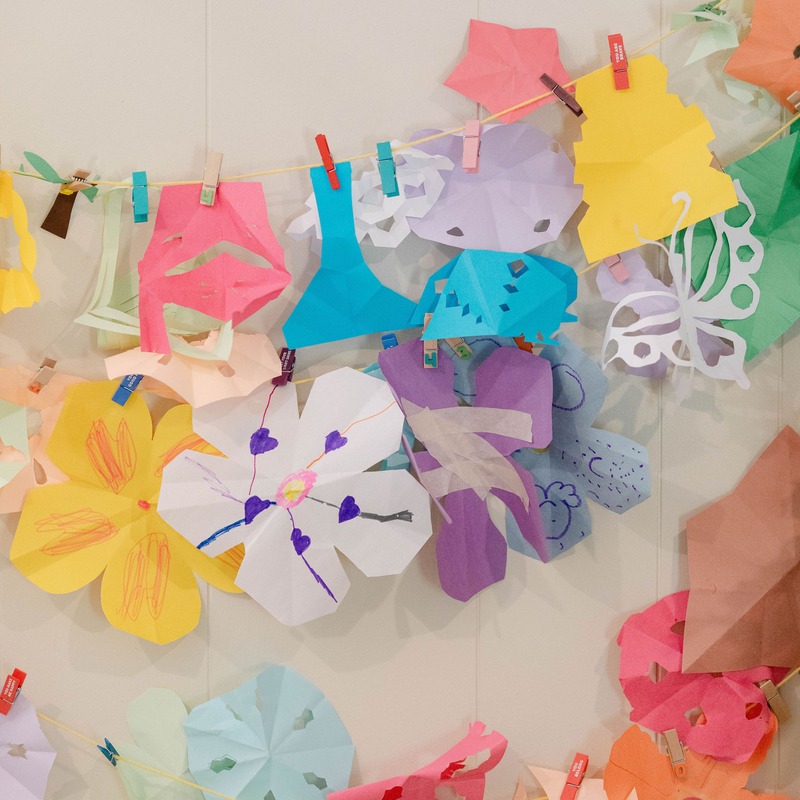
Art: Kids dive into both process art (focusing on the pure joy of making and experimenting) and product art, learning the techniques behind drawing, painting, and sculpting.
Movement: We keep our bodies happy and active with calming meditation, yoga, fun dances, and plenty of collaborative outdoor games.
Music: We explore music theory and rhythmic experiences that match up with what we are already learning in social studies, literacy, science, and our community projects.
Peace Education Curriculum
In a traditional Montessori space, peace education isn’t just “being nice” – it’s grace, courtesy, and a reliable environment for everything we do together. For a self-directed community like ours, it is absolutely essential. Peace education means giving children the real-world tools they need for conflict resolution, emotional literacy, self-care, community service, and a deep, empathetic understanding of diversity and inclusion – and the trust and opportunity to apply them!
A Shift from Control to Connection
Conventional classrooms often rely on a system of rewards, punishments, and strict adult enforcement to keep order. In our schoolhouse, we choose a different path. We believe that true growth happens when we avoid those rigid controls and instead offer freedom within clear limits.
By modeling grace and courtesy, fostering self-regulation, and allowing natural consequences to happen, we shift the ownership and benefit of learning firsthand to the children. When a child is given autonomy, comfort, belonging, and gentle accountability, their learning—both academic and personal—belongs entirely to them, not the teacher or the school.
What Trusted Leadership Looks Like in Practice
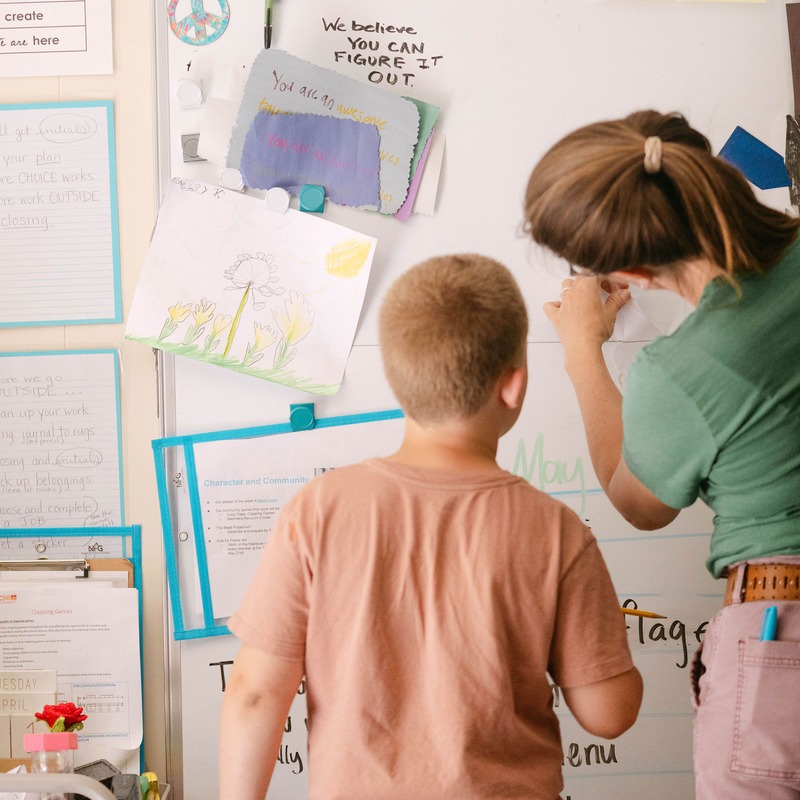
We work side-by-side with our students to build our community expectations and routines, which are clearly displayed and referred to every day. When a child is having a tough moment or needs a little extra support, you won’t hear us lecturing or punishing. Instead, you’ll see our educators:
- Co-regulating with them to help calm their nervous system.
- Offering a gentle cue to try out a learned coping strategy.
- Helping them take a peaceful break or redirecting them back to their plan.
Adult control is only ever used as a last resort to ensure physical safety (of course!). Our supportive environment gives children the space to develop true self-discipline, responsibility, and the lifelong skills needed to navigate both harmony and conflict gracefully.
Peace in Action: Our Kids for Peace Club
We love putting our peaceful values into motion! Peace practices are easy to find woven into our weekly schedules, Montessori Schoolhouse sessions, and STEAM Project labs as we put “Peace into Action” with initiatives for our local chapter of the Kids for Peace club.
Throughout the year, our students lead wonderful, hands-on community projects that connect them to our neighbors. You’re invited to join in too!
Each Fall, support our Annual Food Drive for the Tri-Area Food Pantry.
In Winter, join us in sponsoring a local family for the holidays or visiting local seniors and hosting a fun family fundraising dance for Valentine’s Day.
In Spring, we always roll up our sleeves for a local stream clean-up.
Each summer, we celebrate movement together with our Homeschool Field Day!
Lower Elementary (ages 6-9) vs. Upper Elementary (ages 9-12)
Our programs are designed to support children as they step into what Dr. Maria Montessori called the Second Plane of Development (ages 6–12). This is a transformative window where children stop simply absorbing the world around them and start analyzing it through reasoning and imagination.
Many other developmental pioneers, like Piaget and Vygotsky, Erikson, recorded similar observations of development. During their years in our Schoolhouse, kids naturally transition from following adults to thinking critically about everything. They begin to question what is fair, explore deep beliefs, recognize their own impact on the world, and form their own unique sense of discernment.
Becoming “Companions in Thinking”
At Dandelion Learning, adults lean into this shift with our own wonder. Instead of acting as rigid authority figures or judges, we become “companions in thinking.” Our role is to notice “where they are at” and guide them forward, helping them build the skills they will need as the adults they are growing into.
To do this effectively, our educators focus on a few child-centered practices:
- Preparing the Space: We ensure children always have access to academic and personal tools that match their unique developmental stage.
- Listening Fully: We make sure children’s voices are heard and valued—even when their ideas are still a work in progress!
- Setting Gentle Boundaries: We maintain clear, shared boundaries so children feel safe to explore.
- Respecting Autonomy: We honor their independence and celebrate their unique ideas.
The Quiet, Essential Work of the Teacher
Our teachers spend a lot of time observing and thinking critically themselves. We deliberately give children the time and space to make mistakes, try again, consider how their actions affect others, and adjust their approach.
This patient, gentle process is exactly how a strong reasoning mind, deep confidence, and true self-discipline are born. Our work in this stage is quiet, but it is so important. By bringing our own discernment, warmth, and deep trust to the table, we give your children the space to discover and grow their own!
Alignment with NC Standard Course of Study
How to teach” of Montessori with the “what to teach” of North Carolina and Common Core standards. Because every child grows at their own pace, we don’t lock kids into strict grade levels.
K–8 Materials for All: Our room is filled with learning materials, tools, and books spanning Kindergarten through 8th grade. Every child gets access to the exact lessons they are ready for, regardless of their age.
Bridges to Traditional Schools: We cover all state-required subject topics so that if your child ever transitions to a conventional school, they will be completely prepared and on track.
Perfect-Fit Lessons: We design open-ended activities with multiple entry points. This allows us to easily customize lessons so they are a perfect match for every single learner.
How we assess learning (without grades)
You might notice something missing from our Schoolhouse: letter grades and traditional report cards. We proudly join educational experts like Alfie Kohn, Peter Gray, and Dr. Maria Montessori in stepping away from standard grading systems. And we are very sure about why we do that.
Research shows – and we have seen firsthand in conventional classrooms – that grades can accidentally lower a child’s natural motivation, discourage deep thinking, and create unnecessary stress, comparison, and shame.
Think back to your own school days:
- Were you ever truly, deeply inspired to love a subject just because of an ‘A’ on a paper?
- Were you ever deeply discouraged because of a grade?
- Did a test grade ever completely miss the mark on who you were or how hard you tried?
In our Schoolhouse, we see an effective alternative every day: when you take away the pressure of grades, a child’s natural love for learning takes off!
How We Measure Success Instead
Just because we don’t give grades doesn’t mean we aren’t paying attention to progress! We are here to recognize celebrate your child’s growth.. To make sure they are thriving, we use supportive tools that tell the whole story and foster learning –
- Deep Observation & Daily Support: We spend our days watching how your child learns, jumping in to guide them toward their next step the moment they are ready.
- Living Portfolios: We collaborate with students to build a collection of their work, celebrating their personal best and unique interests. This takes place in two places: their Personal Journals and our SeeSaw class app.
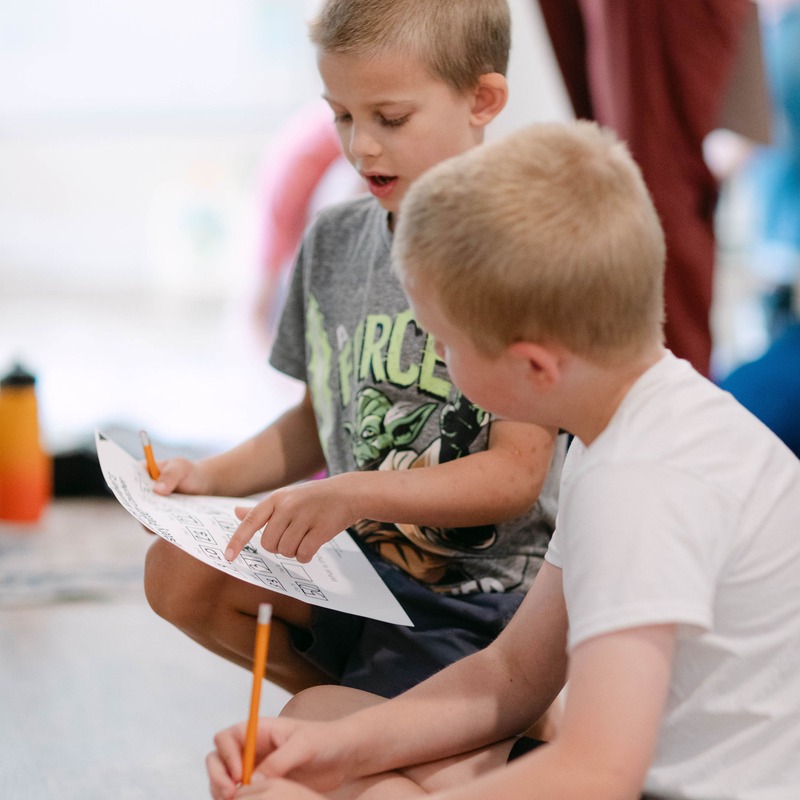
- Expert Academic Tracking: As trained educators, we use specialized tools (like reading running records, phonics assessments, and math inventories) to precisely track your child’s skills across all levels when they are needed.
We choose to focus on the joy of the journey, ensuring your child feels seen, supported, and truly celebrated for who they are!
Standardized Testing
You won’t find our students sitting down for standardized tests together at the Schoolhouse. As homeschoolers in North Carolina, we are required by law to administer an annual standardized test, but we don’t have to report those scores to the state, and you don’t even have to show them to your child (or us, for that matter)..
Because testing is legally tied to your individual home school, the choice of which test to use—and when to take it—is completely up to your family.
We’ve got this together!
Testing can sometimes feel a little overwhelming, but you don’t have to navigate it alone. We are always happy to sit down with our member families to help you:
- Select the best-fit test for your child’s unique personality and learning style.
- Interpret the results with a healthy, supportive perspective once the test is done.
Think of us as your partners in keeping things stress-free and meaningful, ensuring testing remains just a simple checkbox for the state while your child’s love for learning stays in focus.
Highschool Transcripts
While we do not issue traditional report cards, we are fully prepared to support your child’s next steps. If your family plans to transition to a conventional middle school, high school, or another educational program in the future, we are happy to assist you in creating:
- Official homeschool transcripts
- Comprehensive student portfolios
- Detailed academic assessment records
We will work closely with you to ensure you have everything needed for a smooth and confident transition!
Not at all! We never teach academics in a rigid, “lock-step” way to prepare a whole group for a single test. Instead, we give your child access to just-right, high-quality materials and learning experiences at a pace that is completely personalized to them.
The wonderful thing we’ve noticed is that even without “test prep,” children naturally show consistent, ongoing growth on the annual reading, spelling, English, and math assessments required by the state. When learning is joyful, the progress follows naturally!
We don’t host state testing inside our schoolhouse, but you won’t have to navigate it alone! We love partnering with families to help you select the best test for your child’s unique personality and learning goals.
We’re also happy to help you read and interpret the results once they come in. Plus, as trained teachers, we are always happy to provide in-house reading running records, phonics evaluations, and math inventories upon request to give you a clear picture of your child’s growth or current skills.
We believe every child learns best on their own perfect timeline. One of the greatest gifts of our multi-age community is its diversity! In our setting, children with learning differences and children who are academically gifted naturally find the exact materials, extensions, and peer groups they need—opportunities they might miss out on in a conventional, single-grade classroom. Our teachers are fully trained to notice your child’s strengths and needs and provide just rights support or exciting new challenges whenever they are ready.
e always start with the hands and the heart before moving to memory! Before we ever ask a child to memorize a math fact, we give them lots of time to explore patterns.
Using iconic Montessori and modern hands-on materials, children can actually see and touch addition, subtraction, multiplication, and division. We find that when kids play math games, talk about numbers with friends, and write down what they notice, they naturally internalize those math facts without the stress of flashcards.
Dr. Maria Montessori beautifully described the hand as the “instrument of intelligence,” and we couldn’t agree more! Writing is a wonderful, uniquely human skill that helps the brain grow and connects so many different parts of learning.
Our approach to handwriting goes way beyond worksheets. We build up those hand muscles with fun fine-motor activities like sculpting with clay and painting. From there, children trace tactile sandpaper letters, build words with the Moveable Alphabet, and receive gentle, personalized instruction in both print and cursive.