Literacy At Home: skills and love for literacy in your homeschool
Reading to and with children is perhaps one of the most powerful ways to support early literacy development. Research consistently shows that shared reading experiences not only foster a love of books but also build foundational language and cognitive skills necessary for successful reading and lifelong learning. Reading and literacy are essential to everyday life; strong literacy skills empower children to become thoughtful, critical consumers of information and open the door to a deeper understanding of what they encounter in print, online, and through spoken language.
For many homeschool families, reading is woven naturally into the rhythm of the day- by snuggling up with a favorite book, listening to stories, or exploring topics of interest together. These moments are incredibly valuable. However, alongside this rich exposure to language, children also need and benefit from intentional literacy instruction- carefully planned activities that help them to understand how reading works, which in turn allow them to grow as confident, capable readers. Intentional literacy instruction means going beyond the natural opportunities that occur throughout your homeschool days to include explicit phonics instruction, vocabulary development, fluency practice, and comprehension support.
Phonics Introduction
Explicit phonics instruction is a direct and systematic way of teaching children how to read by showing them how letters connect to sounds and how to use those connections to read and spell words. It involves modeling how to blend sounds together to form words and provides for practice and application of skills in both reading and writing. Research shows that systematic, explicit phonics instruction is more effective than unstructured approaches. Homeschool-focused programs include Raising Readers and Reading Rockets. Several widely used and respected mainstream programs include UFLI Foundations, Wilson Fundations, and Logic of English.
Vocabulary Development
Vocabulary development should be ongoing and introduce new words that deepen understanding. Playing different word games, hunting for unknown words in your environment, and learning words in content areas (science, social studies, art) all help children strengthen their literacy skills.
Fluency Practice
Fluency practice provides children with opportunities to read with both accuracy and expression. Fluency aids in comprehension and is an important piece of the literacy pie. Modeling fluent reading is important as children learn to pause at punctuation, use voice inflections, and convey emotion and meaning simply by listening to you. You can share books like the “I Read to You, You Read to Me” series with your child, encourage them to read out loud to younger siblings and even pets, and explore poetry and songs as fun, low-pressure opportunities for children to practice and build fluency.
Comprehension
Comprehension- It is important, as you are reading with your child, that you take time to pause, ask questions, and have conversations about what is being read. It is not just about asking literal questions, where answers are directly stated in the text. Make sure to ask a variety of questions, asking your child to predict, to summarize, and to explain why characters might feel the way they do. Ultimately, you want your child to grow into a critical consumer of information and asking a variety of questions will help build this skill.
The Benefits of Homeschooling and Teaching Literacy
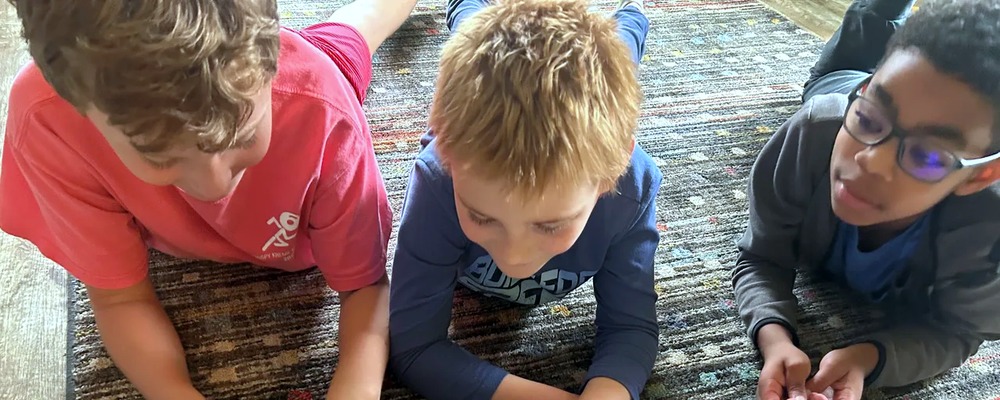
One of the greatest strengths of homeschooling is flexibility, but that can also feel overwhelming at times. This is where a homeschool community like Dandelion can be a powerful partner. At Dandelion, we offer a variety of literary opportunities that complement and enrich what you’re already doing at home. Even if you have a reluctant reader, classroom experiences with other children offer opportunities in science, social studies, art, and math that create meaningful ways to connect literacy skills to real-world learning.
The most effective literacy development happens when children experience both intentional skill-building at home and engaging, collaborative opportunities that bring learning to life. It is in this balance that children not only learn to read but also to love reading and see it as a tool for exploring their interests and passions. Remember, as a homeschool parent, you’re not just teaching your child to read; you are opening doors to curiosity, confidence, and a lifetime of learning.